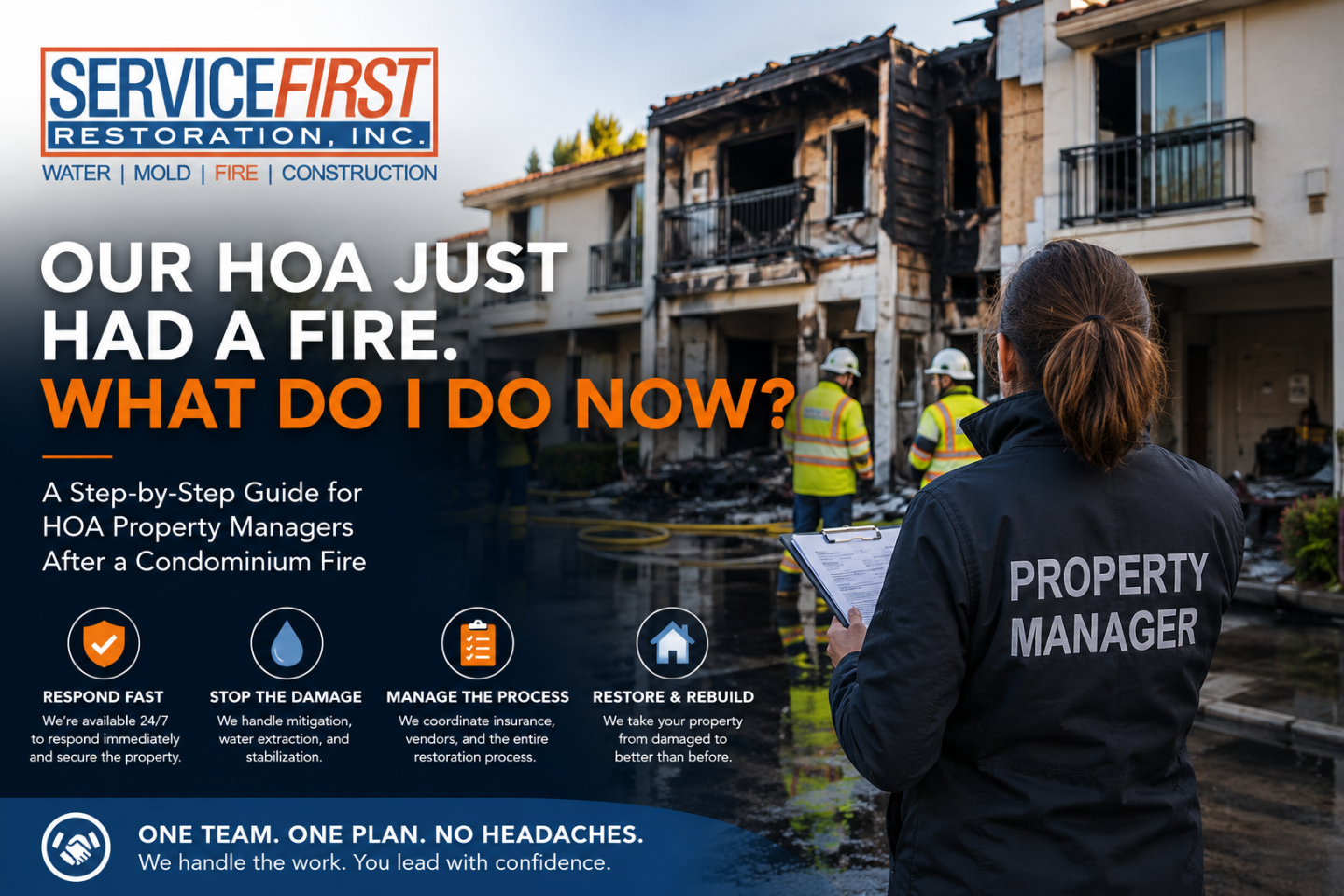
A Property Manager’s Guide to Getting the Right Team in Place and Letting Them Handle the Fire
The call usually sounds something like this:
“Our association just had a fire. It’s a condo community. A couple of units caught fire. What do I do?”
For an HOA property manager, this can be one of the most overwhelming calls you receive.
The fire department is on scene. Homeowners are displaced. The board wants answers. Residents are calling. There may be water everywhere from firefighting efforts. Utilities could be shut down. Insurance needs to get involved.
And suddenly, everyone is looking at you.
Here is the first thing we want property managers to understand:
You don’t need to become a fire-restoration expert.
You need to manage your association.
A good restoration contractor should help manage the fire.
That distinction can make an enormous difference in what happens over the next several days, weeks, and potentially months.
Your First Job: Get the Right People Involved
Immediately after a fire, life safety comes first.
The fire department and other authorities control the scene until it is safe and released. Residents may not be allowed back into their homes. Electricity or gas may be shut off. There may be structural concerns or an active investigation.
Once the immediate emergency is under control, one of the most important calls a property manager can make is to an experienced HOA restoration contractor.
And you’re not just calling them to board up a window or put drying equipment in a unit.
You’re bringing in someone who should help you answer the bigger question:
“What happens next?”
A great restoration contractor becomes part of your emergency-response team and helps drive the process forward so that you don’t have to personally coordinate every moving piece.
A Good Restoration Contractor Should Take Problems OFF Your Plate
There is a major difference between a contractor who simply performs restoration work and a restoration partner who understands HOA property management.
You shouldn’t have to tell your restoration company every little thing that needs to happen.
They should be identifying problems, developing solutions, coordinating the right people, and bringing you decisions when your involvement is actually needed.
After a significant condominium fire, your restoration contractor should help coordinate things like:
- Emergency board-up and securing the property
- Water extraction from firefighting efforts
- Structural drying
- Temporary roof protection
- Smoke and soot evaluation
- Contents protection
- Environmental testing and abatement coordination
- Structural engineering
- Temporary power
- Debris removal
- Reconstruction planning
- Documentation and photographs
- Estimates and scopes
- Insurance adjuster communication
- Specialty vendors and trades
- Permitting and inspections
- Project schedules
- Progress updates
That doesn’t mean the restoration contractor makes decisions for the association.
It means they do the legwork so the property manager and board can make informed decisions.
You Shouldn’t Have to Manage 10 Different Contractors
This is where major losses can become a nightmare for property managers.
Imagine trying to coordinate the restoration contractor, engineer, electrician, environmental consultant, roofer, plumber, adjuster, insurance broker, reconstruction contractor, homeowners, and board members—all while still managing the rest of your portfolio.
That is not a good use of a property manager’s time.
Whenever possible, your restoration contractor should act as the central point of coordination for the restoration process.
If an engineer is needed, they help coordinate it.
If environmental testing is needed, they help get it moving.
If temporary power is needed, they help solve it.
If the building needs to be secured, they handle it.
If something is holding up the project, they should be identifying the bottleneck and pushing toward a solution.
The manager should remain informed and in control without having to personally chase every person involved.
Your Restoration Contractor Should Bring You Solutions, Not More Problems
This is one of the biggest things property managers should look for in a restoration partner.
You already have enough problems.
Your contractor shouldn’t create more of them.
Instead of calling and saying:
“We have a problem. What do you want us to do?”
A strong restoration partner should be able to say:
“We identified a problem. Here are the options. Here is what we recommend. Here is what it will take to move forward. We need your approval on this one item.”
That’s a completely different experience for the property manager.
Your restoration company should be thinking several steps ahead:
What are we waiting for?
Who needs to be involved?
What’s preventing the next phase from starting?
What decision does the board need to make?
What can we solve without creating more work for the manager?
The goal is simple:
We worry about the fire so you can worry about managing your association.
Let the Property Manager Manage
A major fire doesn’t make the rest of a property manager’s portfolio disappear.
You may still have 10, 15, 20 or more other associations requiring your attention.
There are still board meetings.
Homeowner complaints.
Budgets.
Maintenance issues.
Vendors.
Emails.
Phone calls.
And everything else that comes with managing communities.
A fire at one association can consume your entire workday if you don’t have the right team around you.
A good restoration partner understands this.
Their goal should be to reduce the number of things you personally have to touch.
You should know what’s happening without having to constantly ask what’s happening.
Communication Is Part of the Restoration
Restoration isn’t just demolition, drying, cleaning and reconstruction.
For an HOA manager, communication is part of the job.
Your contractor should provide the information you need to communicate confidently with the board and affected homeowners.
You should know:
- What has been completed
- What is happening now
- What happens next
- What you’re waiting on
- Who you’re waiting on
- Whether there are decisions the board needs to make
- Whether there are potential delays
- What the anticipated next milestones are
And when there isn’t an answer yet, your contractor should tell you that too.
One of the worst situations for a property manager is having a board member ask:
“What’s happening with the fire project?”
…and realizing you have to start making phone calls to figure it out.
Your restoration partner should help keep you ahead of those questions.
Don’t Promise What Nobody Can Control
One of the biggest pressures following a condominium fire is the demand for timelines.
Homeowners understandably want to know:
“When can I go home?”
Boards want to know:
“When will this be completed?”
But major fire projects involve many moving pieces.
Engineering, environmental testing, insurance approvals, permits, utility companies, material availability, hidden damage and inspections can all affect the schedule.
A good restoration contractor helps the manager communicate realistic milestones rather than false promises.
Instead of guessing at completion dates, they should help establish:
Here’s what we’ve completed.
Here’s what happens next.
Here’s what we’re waiting for.
Here’s our current anticipated timeline.
Here’s what could affect that timeline.
That’s information a property manager can confidently take back to the board.
The First 24 Hours Don’t Have to Be Complicated
If you receive the dreaded:
“Our HOA just had a fire…”
call, focus on a few priorities.
First, make sure everyone is safe and follow the direction of the fire department.
Notify the board and the association’s insurance professional.
Then get an experienced HOA restoration contractor involved as quickly as possible.
From there, let your restoration team start taking things off your plate.
They should assess the property, document the damage, stabilize the building, identify additional experts that are needed, begin coordinating the response and give you a clear understanding of what happens next.
You remain involved.
You remain informed.
You remain the association’s manager.
But you shouldn’t have to become the restoration contractor too.
Choose Your Restoration Contractor Before You Need Them
The worst time to figure out who you’re going to trust with a major HOA fire is while you’re standing in front of a burning condominium building.
Property managers should know their emergency restoration partner before the emergency happens.
Ask them:
Do they understand HOAs?
Can they handle emergency mitigation and reconstruction?
Can they coordinate engineers and specialty vendors?
How will they communicate with you?
How will they document the project?
Can they work with the association’s insurance professionals?
Who answers the phone at 2:00 a.m.?
And perhaps most importantly:
Will they make your life easier when everything around you has become harder?
Because that’s what a great restoration partner should do.
That’s What ServiceFirst Is Here For
At ServiceFirst Restoration, we understand that when an HOA property manager calls us after a major fire, they’re not simply asking us to clean up a building.
They’re handing us a problem they need help managing.
Our job is to start solving it.
We help coordinate the emergency response, mitigation, documentation, specialty vendors, environmental needs, engineering, insurance communication, reconstruction and the countless details that come with a major property loss.
We keep the property manager informed and involved where they need to be—without expecting them to personally manage every aspect of the restoration.
Because you already have a job.