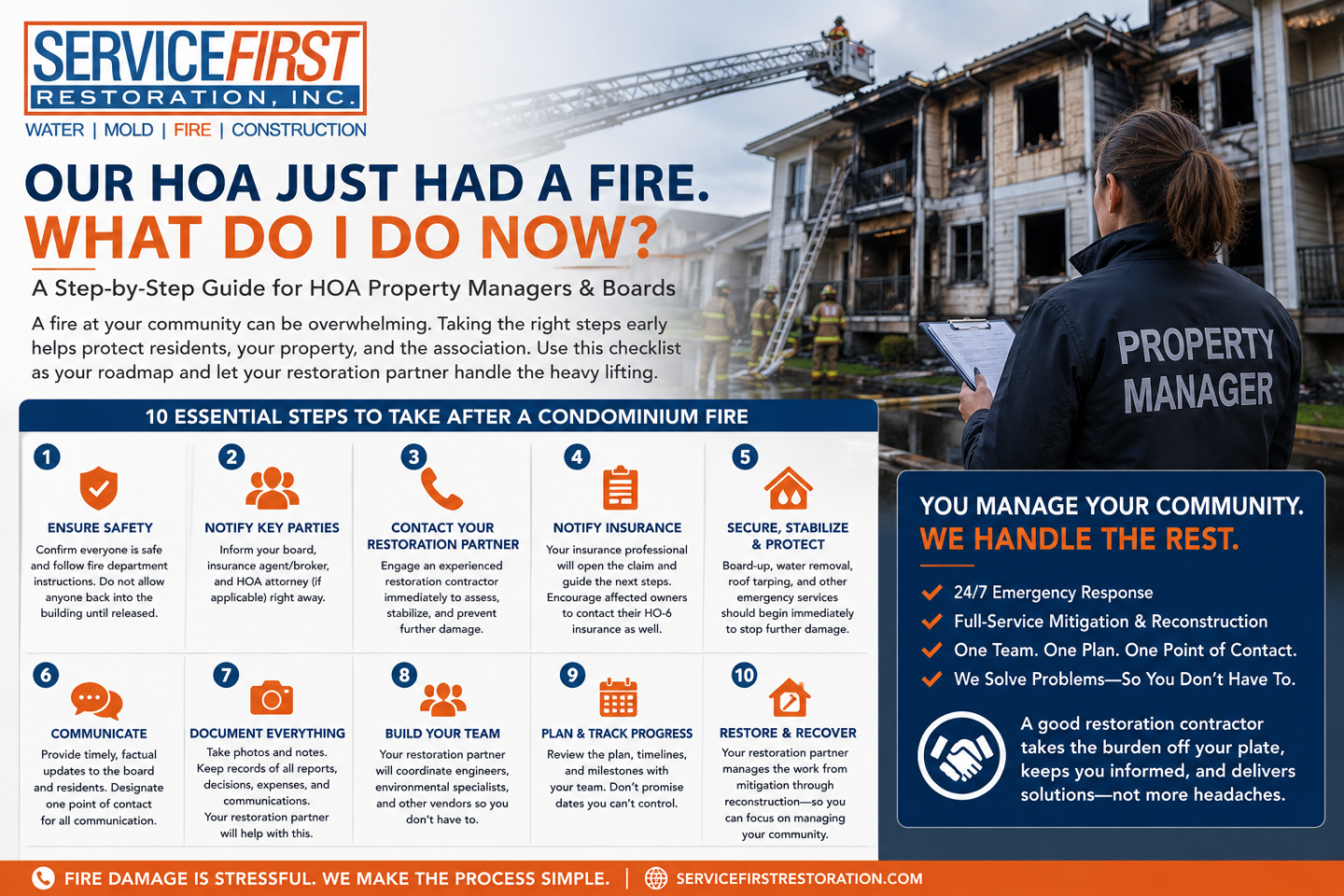
A Step-by-Step Guide for HOA Property Managers After a Condominium Fire
“Our association just caught on fire. They’re condos, and a couple of units were affected. What do I do?”
We’ve received versions of this call many times.
For an HOA property manager, a significant fire can quickly become one of the most complicated situations you will manage.
The fire department may still be on site. Residents want to know when they can return home. Board members are calling. Homeowners are asking who is responsible for what. Insurance carriers need to be notified. Utilities may be shut off. Water from firefighting efforts may have affected units that weren’t damaged by the fire itself.
And everyone is looking to the property manager for answers.
The good news is that you don’t need to have every answer immediately.
You need to know what needs to happen, in what order, and who needs to be involved.
Here is a practical roadmap for navigating the first hours, days, and weeks after a condominium or HOA fire.
1. Start With Life Safety
Before thinking about insurance, restoration, reconstruction, or responsibility, the first priority is safety.
The fire department and other authorities having jurisdiction control the scene until it is released.
Depending on the severity of the fire, residents may not be permitted to enter their homes. Gas and electricity may be shut off. Portions of the building may be structurally unsafe.
As the property manager, avoid making promises about when residents will be able to return.
Instead, begin gathering information:
- Which buildings and units are affected?
- Has the fire been completely extinguished?
- Has the fire department released the property?
- Are utilities shut off?
- Are any portions of the building unsafe to enter?
- How many residents have been displaced?
- Is there an active fire investigation?
- Who is the primary fire department contact?
Your role at this stage is to gather reliable information and establish communication.
2. Activate the Association’s Emergency Team
A significant HOA fire isn’t something a property manager should manage alone.
Depending on the circumstances, the response team may include:
- HOA property manager
- Board representatives
- Association insurance agent/broker
- Insurance adjuster
- Restoration contractor
- General contractor
- Structural engineer
- Environmental consultant
- Electrician
- Plumber
- Roofing contractor
- HOA legal counsel
- Other specialists depending on the loss
One of the most important things you can do early is establish who is responsible for what and how information will flow between everyone.
Without that structure, major losses can quickly turn into dozens of disconnected conversations.
3. Notify the Association’s Insurance Professional
Contact the association’s insurance agent or broker as quickly as reasonably possible.
They can help initiate the claim and determine what information the carrier will require.
Individual homeowners should also contact their own HO-6 insurance carriers regarding their personal property, additional living expenses, improvements, and other potentially covered items.
However, avoid making definitive statements to residents about what the association’s policy or their individual policy will cover.
Insurance coverage and responsibility can be complicated in condominium losses.
The safer approach is:
“We are gathering the information and coordinating with the appropriate insurance professionals. Coverage determinations will need to come from the applicable insurance carriers.”
4. Get an Experienced Restoration Contractor Involved Early
Even after the fire is extinguished, damage may continue.
Firefighting operations can introduce significant amounts of water into the structure. Smoke and soot can travel well beyond the units where the actual fire occurred. Roof openings, broken windows, or damaged doors can expose the building to weather or unauthorized entry.
Early emergency services may include:
- Emergency board-up
- Temporary roof protection
- Water extraction
- Structural drying
- Debris removal
- Smoke and soot evaluation
- Contents protection
- Temporary power
- Temporary fencing or security
- Environmental testing
- Emergency stabilization
The objective is simple:
Stop additional damage and stabilize the property.
This doesn’t necessarily mean beginning full reconstruction immediately. It means taking reasonable steps to prevent an already serious loss from becoming worse.
5. Understand That Fire Damage Extends Beyond What Burned
One of the biggest misconceptions after a condominium fire is that only the visibly burned units are affected.
A fire can create several different types of damage.
Direct Fire Damage
These are materials physically damaged or destroyed by flames and heat.
Smoke and Soot Damage
Smoke can migrate through attics, wall cavities, HVAC systems, corridors, neighboring units, and common areas.
A unit may appear relatively untouched while still requiring professional evaluation and cleaning.
Water Damage
Firefighters may use substantial amounts of water to extinguish the fire.
That water can travel vertically and horizontally through a condominium building, affecting units that were nowhere near the original fire.
Structural Damage
Framing, roof systems, trusses, floor systems, and other structural components may need to be evaluated by qualified professionals.
Environmental Concerns
Depending on the age of the property and the materials involved, asbestos, lead, or other environmental considerations may affect demolition and restoration procedures.
That is why the true scope of a condominium fire often isn’t known on the first day.
6. Determine What Is Association Responsibility vs. Homeowner Responsibility
This is often one of the first questions homeowners ask:
“Who is responsible for fixing my unit?”
Unfortunately, there isn’t one universal answer.
Responsibility can depend on:
- The association’s governing documents
- CC&Rs
- Maintenance responsibilities
- The association’s insurance policy
- Individual HO-6 policies
- Cause and circumstances of the fire
- Applicable laws
- Insurance coverage determinations
The property manager should help coordinate the process, but should generally avoid making legal or coverage determinations independently.
When responsibility is unclear, involve the association’s insurance professional and, when appropriate, HOA legal counsel.
7. Establish One Source of Truth
Communication becomes one of the biggest challenges after a major fire.
Homeowners talk to neighbors. Board members hear different information. Contractors are discussing scopes. Adjusters are requesting documentation. Rumors begin spreading.
Before long, five different versions of the same situation can exist.
Establish a clear communication structure early.
Determine:
- Who communicates with homeowners?
- Who communicates with the board?
- Who communicates with the insurance adjuster?
- Who communicates with contractors?
- How frequently will updates be provided?
- Where will documents, reports, photos, estimates, and schedules be stored?
Even when there is no major update, communication matters.
Sometimes the most useful message is simply:
“There has been no significant change since our last update. Here is what we are currently waiting for and what happens next.”
Silence creates uncertainty. Consistent communication creates confidence.
8. Document Everything
Major fire losses can take months—or longer—to completely resolve.
Documentation becomes extremely important.
Maintain records of:
- Photos and videos
- Fire department information
- Vendor reports
- Moisture documentation
- Environmental reports
- Engineering reports
- Estimates
- Proposals
- Insurance correspondence
- Board decisions
- Authorizations
- Change orders
- Resident communications
- Important phone conversations
- Project timelines
Don’t rely on memory.
A decision that seems obvious three days after the fire may be difficult to reconstruct six months later.
9. Don’t Promise Dates You Don’t Control
This is one of the hardest lessons in managing large losses.
Everyone wants a date.
“When can I get back into my home?”
“When will demolition start?”
“When will the engineer be finished?”
“When will reconstruction begin?”
“When will everything be completed?”
There are many dependencies outside the property manager’s control:
- Fire investigations
- Insurance approvals
- Environmental testing
- Engineering
- Architectural plans
- Permitting
- Material availability
- Utility companies
- Contractor schedules
- Hidden conditions discovered during demolition
Give homeowners the best information available, but clearly distinguish between a target, an estimate, and a confirmed commitment.
It is better to communicate uncertainty accurately than to provide a confident date that later has to be withdrawn.
10. Prepare for the Project to Change as More Is Discovered
Fire restoration is rarely completely understood on Day One.
Additional damage may be discovered as demolition progresses.
An engineer may identify structural repairs.
Environmental testing may affect demolition procedures.
The building department may require upgrades.
Insurance scopes may change.
Materials may have long lead times.
The initial plan should therefore be treated as a roadmap—not a guarantee that nothing will change.
What matters is having a process for identifying changes, communicating them, documenting decisions, and keeping the project moving.
What Should an HOA Manager Do in the First 24 Hours?
When everything feels overwhelming, focus on the immediate priorities:
- Confirm everyone is safe and follow fire department instructions.
- Identify the affected buildings and units.
- Notify the board.
- Notify the association’s insurance agent/broker.
- Engage an experienced restoration contractor to assess and stabilize the property.
- Address board-up, water extraction, temporary protection, and other emergency needs.
- Identify displaced residents and provide clear communication about what is known.
- Begin documenting the loss.
- Establish who will communicate with residents, the board, insurance, and vendors.
- Schedule the next project update—even if all the answers aren’t available yet.
The Property Manager Doesn’t Have to Know Everything
This may be the most important point.
When a major condominium fire occurs, the property manager often becomes the center of the response.
But that doesn’t mean you are expected to personally know how to engineer a damaged roof system, interpret an insurance policy, perform environmental remediation, estimate reconstruction, or determine legal responsibility.
Your job is to assemble the right team, organize the process, communicate effectively, protect the association’s interests, and keep the project moving forward.
A good restoration partner should make that job easier—not create another problem for you to manage.
ServiceFirst Restoration: Helping HOA Managers Navigate Major Property Losses
ServiceFirst Restoration has worked with HOA managers, boards, homeowners, insurance professionals, and other stakeholders throughout Southern California on water, fire, smoke, mold, emergency mitigation, and reconstruction projects.
When an HOA experiences a significant fire, our role goes beyond simply showing up with equipment.
We help assess the property, stabilize the loss, document conditions, coordinate with the appropriate parties, communicate throughout the process, and develop a path from the initial emergency through restoration and reconstruction.
If you’re an HOA property manager dealing with a condominium fire and you’re not sure what the next step should be, call us.
You don’t need to have everything figured out before you make the call.
That’s why you build the right emergency-response team before you need it.